Measured off the drawing.
Priced off your rates.
Grid, MF, plasterboard, acoustic — this trade is metres and square metres, and the money is won or lost in how accurately and how fast you measure them. Vyntworks takes the quantities straight off the PDF drawings and prices them from your own rate cards, so a tender that used to take a weekend takes an afternoon.
Set up by our team. We load your rate cards at setup, and your estimators learn takeoff in the Vyntworks Academy.
Lengths and areas that trace back to a line on a drawing.
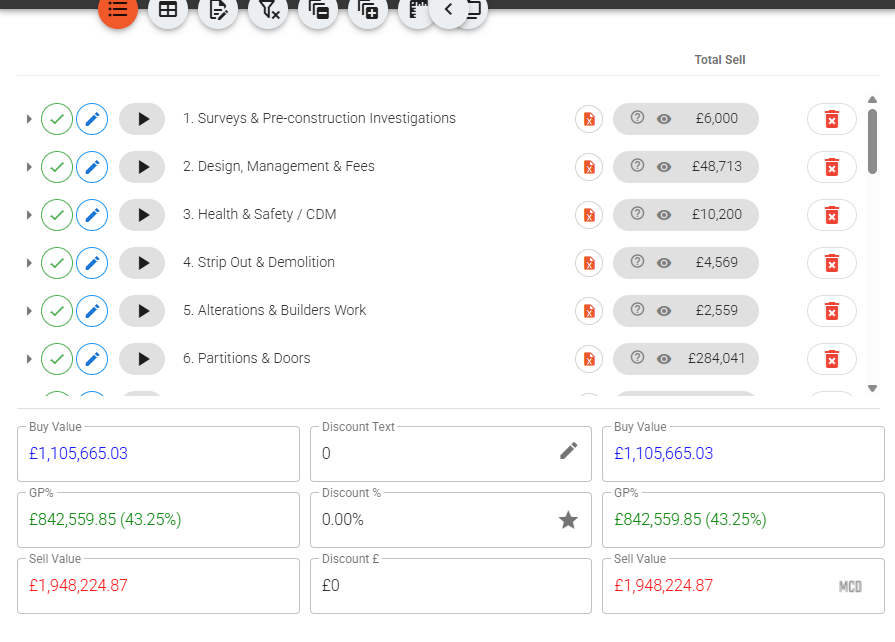
Calibrate the page, measure partition runs by length and ceilings by area into colour-coded groups, and link the totals to your quote lines. When Revision C lands, a drift badge flags exactly which quantities moved — no silent changes, no re-measuring the whole floor.
- Linear, area and count takeoff from the issued PDFs
- Area-based pricing straight from your rate cards
- Drift flags when a re-issued drawing moves a quantity
- Every number traceable to a measurement, not a memory
Three subs, three formats, one honest comparison.
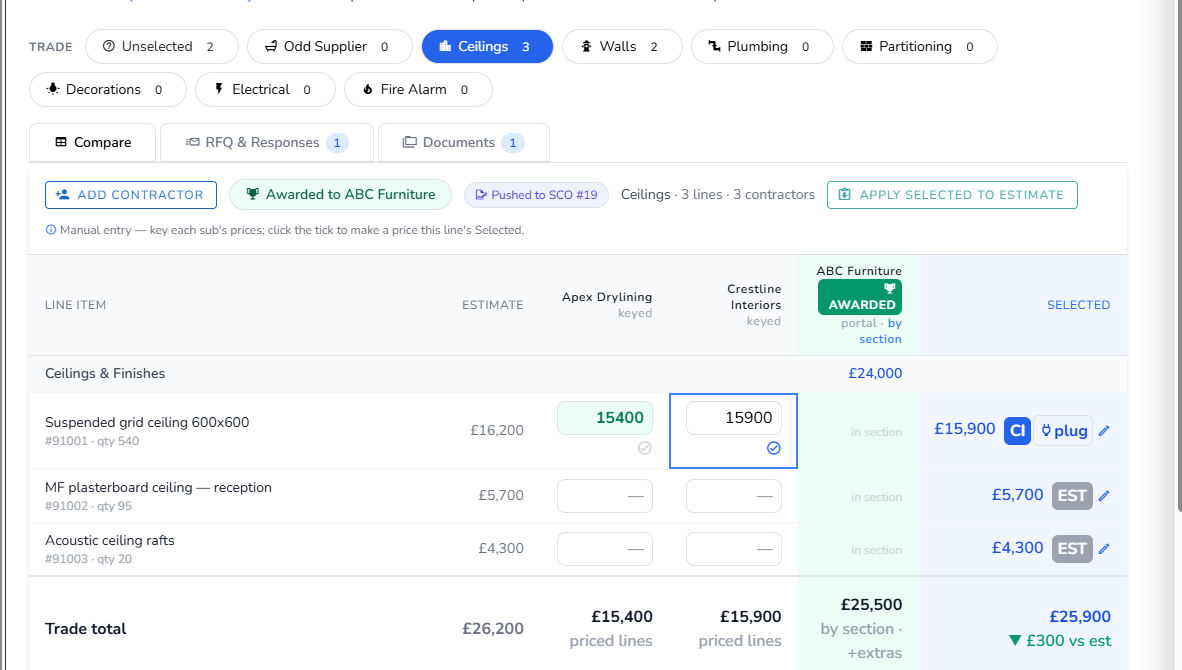
Every sub quotes the package a different way — different inclusions, different exclusions, different line structures. The tender board puts every return in its own column against your lines and your target rates, so you award on a like-for-like number instead of the cheapest headline.
- Subs price online in a secure portal, against your lines
- Line-by-line comparison with gaps exposed
- Award converts to a subcontract order with a full document pack
From awarded package to signed-off snags.
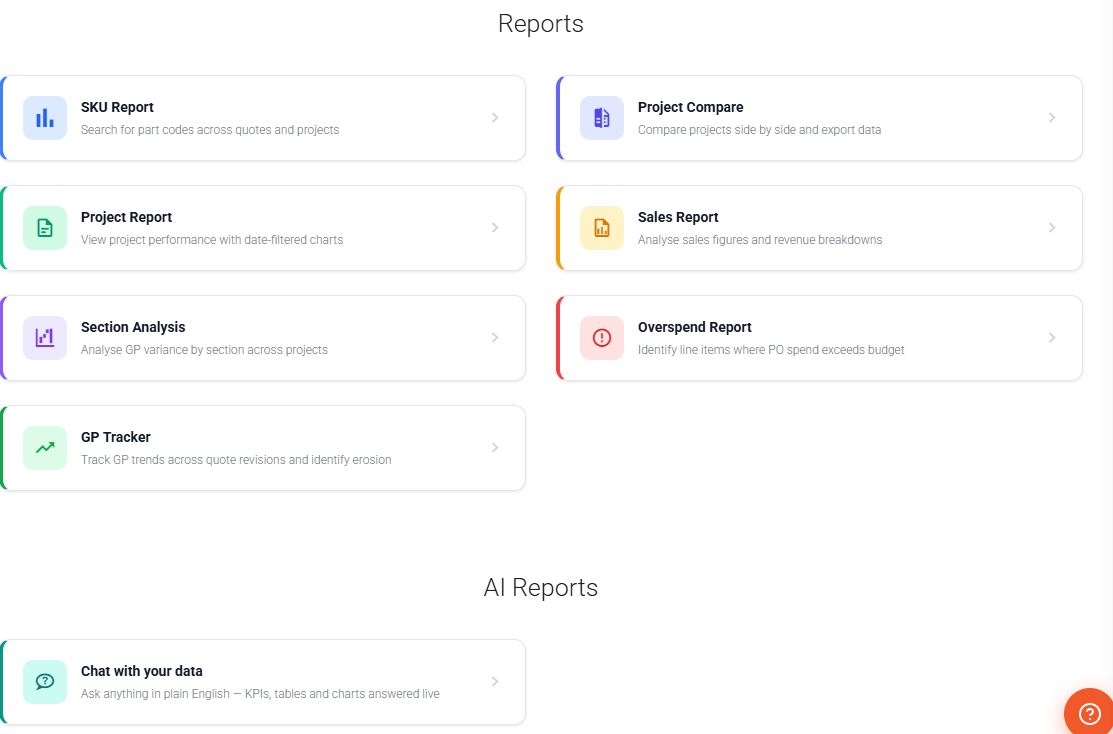
Variations priced as they happen, valuations and applications for payment out on time, and live CVR holding each job's budget, committed and actual side by side. Site teams work snag lists to three-stage sign-off; your AI colleagues watch the numbers and draft the paperwork — every action approved and logged.
- Variations on paper in a minute, not lost on site
- Applications for payment with retention
- Snagging with three-stage sign-off
- Overspend alerts before margin slips
From the GA plan to the last deflection head.
Drylining is measured work with a lot of detail hiding in each system: board layers, stud gauges, deflection heads, fire stopping, bulkheads and openings. Here is how a ceilings and partitions package moves through Vyntworks.
Partitions by metre run, per type
Trace each partition type — P1, P2, P3 — as a linear run, carried straight through door openings on the sheet. Ask for “P2 partitions” and the run comes back typed under the drawing’s own legend.
Ceilings by area, bulkheads by length
Measure MF and suspended grid ceilings by m² per room or zone, and bulkheads, margins and perimeter trims as lengths. Access hatches and downlight cut-outs are counts on their own lines.
Build the system, layer by layer
A partition rate is boards per side, stud, insulation, deflection head, tape and joint and labour. Hold each system as a build-up of sub-items — so a two-layer fire-rated wall is visibly different from a single-layer one.
Rate cards per system and client
Price tables hold your rates per system, and per client where they differ. Fire-rated and acoustic specifications come from the spec library, so the performance you priced is the performance written on the quote.
Tender the labour and compare like for like
Send the package to your fixing gangs or subs through the tender portal. Returns line up against your measured lines, exclusions are priced at your estimate, and the levelled total shows the true lowest.
Re-issued drawings without a full re-measure
When revision C arrives, drift flags show which linked quantities moved, and the two-way completeness check catches a bulkhead run measured but never priced, or a priced line with nothing measured behind it.
Where drylining margin goes: openings, heads and the second layer
The quantities that lose money are rarely the big wall areas. They are the door openings that need extra studs and head detail, the deflection heads that were assumed standard, the fire stopping at every service penetration and the second board layer that a fire strategy added after tender. Measuring openings by count and heads by length, on lines of their own, makes those items visible to whoever checks the bid — see what good takeoff looks like.
Ceilings and partitions are often let as a package inside a commercial fit-out, which is exactly where the four places fit-out margin leaks show up. Keep one live revision of the quote as the design changes — why that matters — and the won price carries into orders, variations and valuations without being retyped.
Guides for ceilings & partitions contractors:
What is takeoff in estimating? → Compare subcontractor prices line by line → Which quote version is live? → Where fit-out margin leaks →
Ceilings & partitions firms usually ask
We price per m² from rate cards that change by client — supported?
Yes — price tables can be held per client as well as per supplier, so the same measured area prices differently for different customers automatically. Update a rate once and every future quote uses it.
How much faster is takeoff, really?
The quantities land directly in the estimate — no scale rule, no notepad, no re-typing — so measuring a floor becomes part of pricing it. The bigger win is re-measures: when a drawing is re-issued, only the flagged quantities need looking at.
Our margins are thin — where does Vyntworks protect them?
Three places: measured (not guessed) quantities at tender; line-by-line sub comparison so you don’t buy a problem; and live CVR with overspend alerts during delivery, so drift shows up while you can still act on it.
Do we measure partitions in metres or square metres?
Either — it is your rate card that decides. Many firms price partitions per metre run at a stated height and ceilings per m². Takeoff gives you both lengths and areas, so each line uses the unit its rate is set in.
Can fire-rated and acoustic systems be priced differently from standard ones?
Yes. Hold each system as its own product or build-up with its own boards, insulation and labour, and pull the performance wording from the spec library so the quote states exactly what was priced.
Can our fixing gangs see only their own work?
Yes. A freelancer login shows a gang or sub only the quotes, projects and snag lists you grant them, so they can update their snags without seeing the rest of the job or your margin.
See it on one of your drawings.
Book a walkthrough and bring a live tender drawing — we'll measure a floor and price it from your rates while you watch.