Ask a commercial director where they lost margin on a job and you will rarely get a single answer. It is almost never one bad decision. It is a slow drain — a few percent here, a missed variation there — spread across months and across systems that do not talk to each other.
After watching hundreds of fit-out and contracting projects move from tender to final account, the same four leaks show up again and again. None of them are dramatic. That is exactly why they are dangerous.
1. The estimate that nobody can trace
It starts with a spreadsheet called something like Final_v3_REV-C_actual-final.xlsx. By the time the job is won, three estimators have worked from copies, a formula has been dragged one row too far, and the number you committed to is no longer one anybody can fully explain.
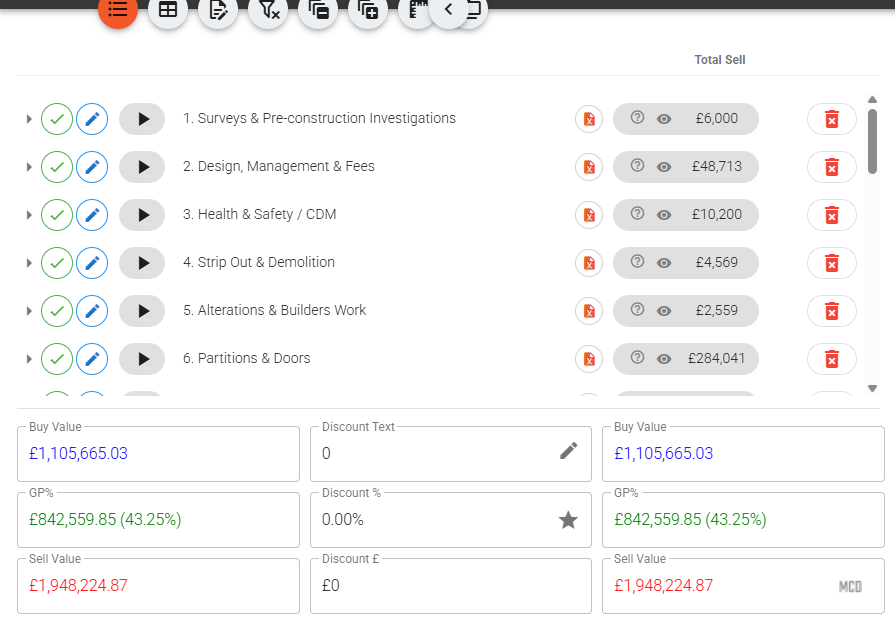
When the quote and the live project are the same connected model — not a workbook that gets re-keyed into a project system — the number you priced is the number you deliver against. There is no translation step where margin can disappear.
2. Procurement that drifts from the estimate
You priced a partition at one rate. Twelve weeks later a buyer raises an order at another, against a different supplier, with no line back to the original estimate. Multiply that across every package and the committed cost quietly parts ways with the budget you won the job on.
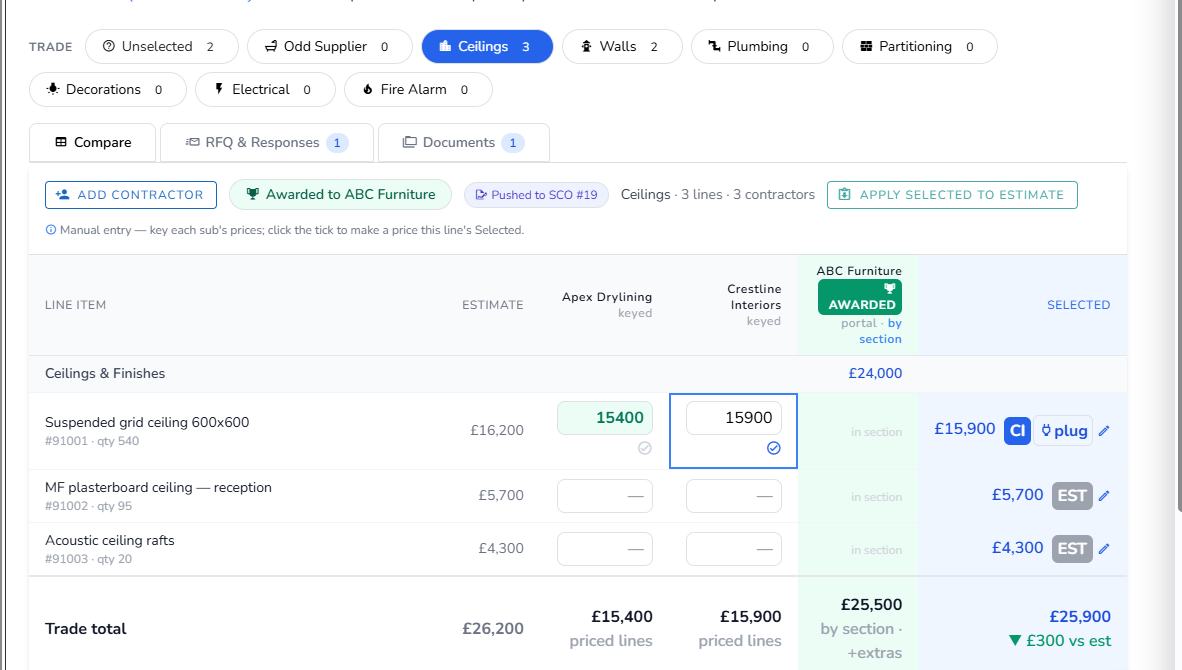
Raising orders straight from the estimated lines — and tendering packages line-by-line before you award — keeps procurement anchored to the number you actually priced.
3. Variations that never make it onto the account
This is the quietest leak of all. A client asks for a change, the team does the work, and in the rush it never gets formally captured, priced and approved. The cost lands on your side of the ledger; the value never lands on theirs.
If a variation isn't captured the day it happens, it is already at risk of becoming free work.
Client, internal and subcontractor variations all need somewhere structured to live, with approval built in — not a fifth spreadsheet that someone updates when they remember.
4. A final account reconciled too late
By the time cost and value are reconciled — often weeks after the money was committed — it is far too late to do anything about a job that has slipped. Live cost-value reconciliation turns that post-mortem into an early-warning system: earned against committed against actual, updated as the project runs, not after it ends.
None of these four leaks is solved by working harder in the same fragmented tools. They are solved by closing the gaps between them — so the quote you send, the costs you commit and the account you settle are all the same connected model.
That is the whole idea behind Vyntworks. If you would like to see it on one of your own jobs, book a walkthrough and we will import a real spreadsheet so you can watch the cracks close on your own numbers.