Most contractors run a cost-value reconciliation once a month, a week or two after the period has closed, so the surveying team can walk into the finance meeting with a number. By then the number is history. The money that moved the job was committed weeks ago; the CVR just confirms where it landed.
That is the quiet problem with reconciliation done as a ritual rather than a running view. A CVR is genuinely useful, but only if it tells you something while you can still act on it. So it is worth being precise about what the report actually shows — and when it stops being an early warning and becomes a post-mortem.
The four numbers, side by side
A CVR earns its keep by putting four figures for the same job in one row and letting the gaps between them speak.
- Budget — what you priced the work at when you won it. This is the number the whole job is measured against, and if it can't be traced back to the estimate you committed to, everything downstream is guesswork.
- Committed — what you have already spent on paper: every purchase order to a supplier and every subcontract order, whether or not the invoice has landed. This is the number that surprises people, because a commitment binds you the moment the order is raised, not when it is paid.
- Actual — the cost that has genuinely hit the job: matched invoices, including those pulled through from your connected accounting software.
- Forecast final — where the job is heading if the current trend holds, which is the figure that tells you whether you still have a problem you can fix.
Vyntworks brings these together on the Finance → CVR tab, a cross-project roll-up with a column each for Budget, Committed, Actual and Forecast Final, plus Recognized revenue to date, the resulting Variance — shown in red the moment it turns negative — and a live GP %. Open any row and you get that project's full CVR grid. The cost totals are not re-typed from a spreadsheet; they come straight from the same orders and invoices the rest of the system already holds.
Why the timing is the whole point
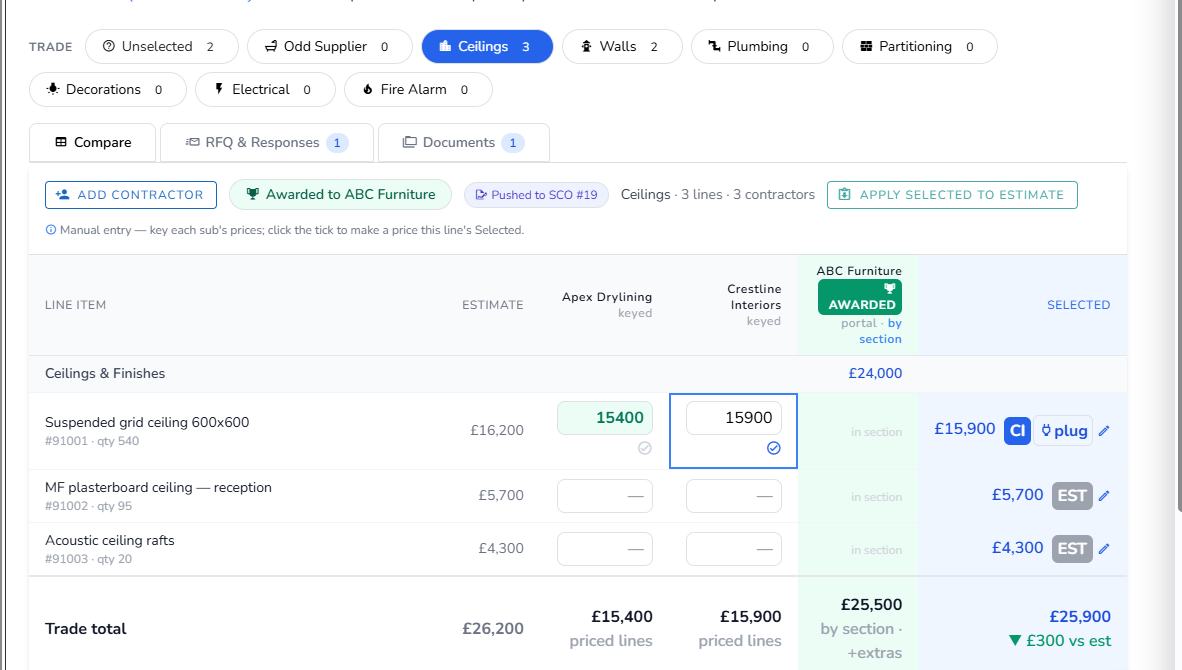
Look at those four numbers and the value of doing this live becomes obvious. Committed cost is the leading indicator. On a fit-out job you might commit £180,000 of joinery and M&E packages in a fortnight — orders raised, subcontractors mobilised — long before a single one of those invoices is matched to the actual column. If your CVR only ever reflects actuals, you are blind to that £180,000 until it is far too late to renegotiate a package, challenge a rate or claw the position back with a variation.
A committed figure that updates as orders are raised changes the question you can ask. Instead of "why did we lose money on that job?" in the post-completion review, it becomes "this package is tracking over the budget line we won it on — what do we do this week?" Same reconciliation, completely different value, and the only thing that changed is when you saw it.
Where the numbers come from
A CVR is only as honest as its inputs, which is why the report should be a by-product of the work rather than a separate modelling exercise. In Vyntworks the committed figure is the sum of the real purchase and subcontract orders raised against the project — the same orders that route through your authorisation tiers before they go live. Actual cost is the matched invoices behind them, Xero included where you have it connected. Recognized revenue follows the project's valuations, switching to the client-agreed certified position the moment an application for payment is agreed rather than staying on a surveyor's live estimate.
Because every one of those inputs is anchored to the estimate the job was won on, the reconciliation reconciles itself as the project runs. Nobody re-keys committed cost into a workbook, nobody reconciles a valuation against a separate cost tracker, and the forecast final is not a number somebody typed hopefully into a cell — it falls out of the orders and applications that already exist.
That is the whole point of keeping quote, procurement and valuation in one connected model: the CVR stops being a monthly reconstruction of what already happened and becomes a running read on where each job actually stands. If your reconciliations are landing too late to change the outcome, book a walkthrough and we will build the CVR on one of your own live projects so you can see committed, actual and forecast move in real time.