The final account is the last argument of a construction job, and often the hardest. Months after the work is finished, someone has to prove — line by line — what the contract was worth, what changed along the way, and what is still owed. On a fit-out that ran for the best part of a year, that means reassembling a story from valuations, variation instructions, emails, marked-up drawings and a spreadsheet that stopped matching reality somewhere around week six.
The frustrating part is that every figure in a final account existed somewhere while the job was live. The account only becomes painful because nobody kept those figures in one place as they were agreed. Here is what a final account has to pull together — and how to make it assemble itself instead.
What a final account actually has to reconcile
Strip away the paperwork and a final account settles a single question: what is the adjusted contract sum, and how much of it has already been paid?
Getting there means reconciling four moving parts:
- The original contract sum — what you were engaged to do.
- Agreed variations — every client-instructed change, added or omitted, each with its agreed sell value.
- The certified position — the running total of what the client's payment notices have actually accepted, application by application.
- Retention — the slice held back on each valuation, due for release in stages after practical completion.
Miss one and the account is wrong. Value the variations low, or lose track of which were genuinely agreed rather than merely instructed, and you leave money on the table at the exact moment you have the least leverage to claw it back.
Why it turns into a scramble
The reason the final account is dreaded is that it is usually a reconstruction. The estimate lived in a workbook. The variations lived in an email thread and a site diary. The applications went out from a different spreadsheet each month. Retention was tracked — if at all — in a column somebody remembered to update.
So the surveyor spends a fortnight cross-checking documents that were never designed to reconcile, chasing sign-off on changes the client now "thought were included", and defending a number they can no longer fully evidence. Every gap between those systems is a place where an agreed change quietly falls out of the account.
The account that assembles itself
The alternative is to stop treating the final account as a document you build at the end, and start treating it as the running sum of decisions you already recorded.
That only works if quote, variations and valuations are the same connected model. In Vyntworks they are. A variation is captured the day it happens, priced, and routed for approval — and it carries two values: the buy that feeds the subcontract order, and the sell that stays on the variation for the client's final account. Nothing has to be re-entered later; the agreed sell value is already sitting on the account, tagged as agreed rather than pending.
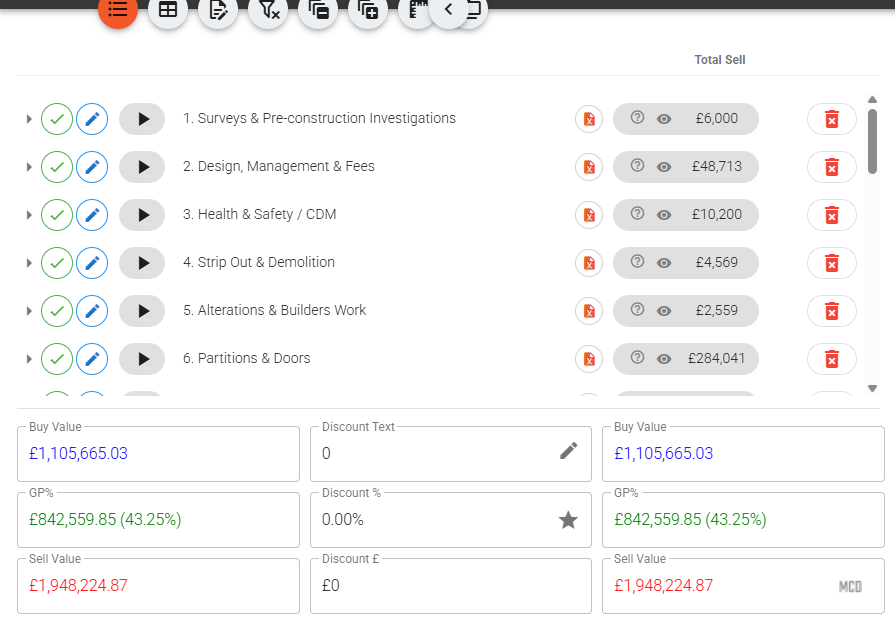
Applications for payment work the same way. Each valuation records what you applied for and what the client certified, so the certified position is a running total rather than something you tot up from twelve PDFs at the end. Recognised value switches to the client-agreed figure the moment an application for payment is agreed, instead of staying on a surveyor's optimistic estimate. Retention is held and released on a schedule the system already knows, so the outstanding balance is never a guess.
Because every one of those inputs is anchored to the estimate the job was won on, the final account becomes a by-product of the work rather than a separate exercise. On any given week you can see the adjusted contract sum, what has been certified, what retention is outstanding and what is left to settle — not because someone rebuilt it, but because it was never allowed to drift apart in the first place.
That is the difference between a final account you dread and one you can open at any point in the job and trust. If yours currently arrives as a fortnight of reconstruction, book a walkthrough and we will build the account on one of your own projects so you can watch it settle as the job runs.