Every fit-out firm has a house way of describing its work. The performance spec for a 60-minute fire-rated partition. The build-up of an acoustic ceiling. The finishes schedule for a reception fit-out. It is genuinely valuable writing — clauses refined over years of jobs, chosen words that head off a dispute before it starts.
The problem is where that writing lives. It lives inside old quotes. So when an estimator needs the partition spec, they open last month's tender, find the nearest job, and copy the paragraph across. Whatever was in that particular quote — including the typo, the client-specific caveat, the rate that was true in 2023 — comes with it.
The cost of copy-and-paste specs
Do that across a busy pipeline and your specifications quietly drift apart. One estimator's fire-rating clause says one thing; another's says something subtly different, because they copied from different source jobs. A product code that changed last spring is still going out on quotes because nobody updated the twelve places it was pasted into. When a client queries a line, the person answering cannot be sure the wording in front of them is the wording your firm actually stands behind.
None of this is a disaster on any single quote. It is a slow erosion of consistency — and consistency is most of what a specification is for. A spec that contradicts itself across two tenders to the same client is worse than no spec at all.
The deeper issue is that the good wording is trapped. It exists, it is correct, but it is only reachable by knowing which old job to raid. New estimators do not have that map, so they either reinvent the clause or ask someone who does — and your best specification writing stays locked in one person's memory.
Write it once, drop it into any quote
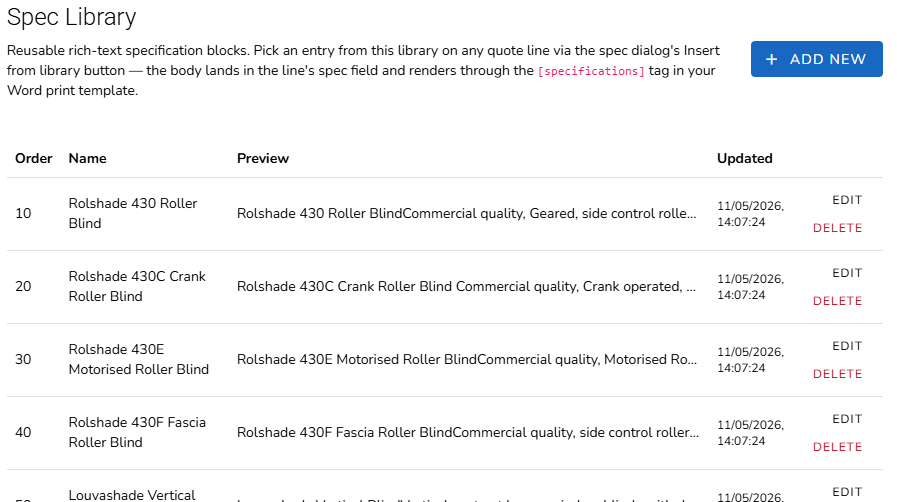
Vyntworks gives specifications one home: the Spec Library. It is a flat list of reusable blocks — your fire-rating clause, your ceiling build-up, your standard access and welfare caveats — each written once in a proper rich-text editor and stored under a clear name. Headings, bold, lists, colour, tables: it all survives into the printed Word quote exactly as you wrote it.
Building a quote, you no longer hunt for an old job to copy. On any line you open the spec editor, click Insert from library, and search for the block you want. Click it to drop the wording straight in, or use Append to stack several blocks in one line — the partition build-up, then the fire-rating clause, then the finish. You can also attach specs at the level of the whole quote, from the quote's menu, so your standard preliminaries and exclusions print once at the top rather than being retyped on every job.
Because the block came from the library and not from a random old tender, the partition spec on this quote reads identically to the partition spec on the last fifty. That is the whole point.
One practical detail worth knowing: the library is not locked to admins. Any signed-in estimator can open it, add a block, or tidy one up — so the library grows with the team's real writing rather than waiting on one gatekeeper. And spec blocks are usually near-identical variants of each other, so the fastest way to add the "80-minute" version of a clause is to duplicate the 60-minute one and change the number, not to start from a blank editor.
Update the wording in one place
The quiet win comes the day a product code changes, a supplier reformulates a board, or a clause needs tightening after a job went sideways. In the old world that means finding every quote the wording ever touched — you won't. In Vyntworks you edit the one library entry, and every future quote that inserts it carries the corrected text automatically.
Deleting a block is just as safe. When you remove an entry, Vyntworks spells it out before it acts: quotes that already used it keep their spec text — only the reusable library row goes. So you can prune retired clauses without rewriting history on jobs you have already sent.
The result is the thing that is genuinely hard to achieve by hand: every quote your firm sends describes the same work in the same words, and when the right words change, they change everywhere at once.
If your specifications currently live scattered across old tenders, book a walkthrough and bring a few of your standard clauses — we'll load them into a spec library and drop them into a real quote, so you can see your own wording come out consistent on the first try.